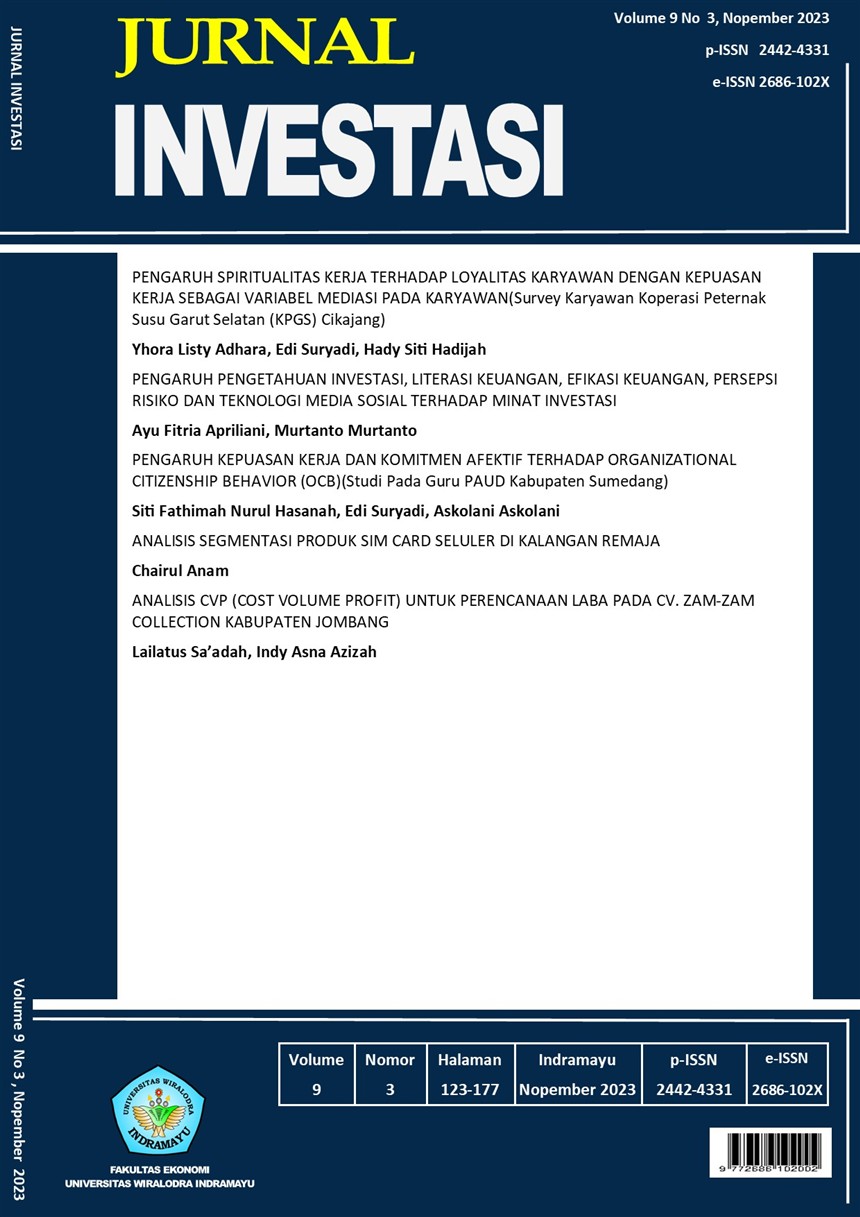
PENGARUH KEPUASAN KERJA DAN KOMITMEN AFEKTIF TERHADAP ORGANIZATIONAL CITIZENSHIP BEHAVIOR (OCB)
(Studi Pada Guru PAUD Kabupaten Sumedang)
DOI:
https://doi.org/10.31943/investasi.v9i3.284Keywords:
Job Satisfaction, affective Commitment, Organizational Citizenship Behaviour (OCB)Abstract
This study was conducted to determine the effect of job satisfaction on organizational citizenship behavior with affective commitment as a mediating variable in PAUD teachers in Sumedang District. Organization need to develop its human resources in a way that can build the high level of Organizational Citizenship Behaviour (OCB). Job satisfaction and affective commitment can became an important factor which affecting OCB. The aim of this study is to identify the mediating role of affective commitment in the relationship between job satisfaction and OCB. The samples were derived from a survey using 20 items questionnaire distributed to the 64 teachers of early childhood education in Kabupaten Sumedang. The bootstrap confidence interval used to measure the mediation. The analytical techniques used in this study will use Structural Equation Modeling – Partial Least Square (SEM-PLS) analysis. The result revealed that there was a direct and indirect effect in the relation between job satisfaction and OCB. Since the interval did not contain zero in the equation, then the research found these relations was mediated by affective commitment. Affective commitment indeed contributes as mediator in the effect of job satisfaction on OCB.
References
Akbar, F., Hamid, D., & Djudi, M. (2016). Pengaruh Kepuasan Kerja Terhadap Komitmen Organisasional dan Kinerja Karyawan. Jurnal Administrasi Bisnis S1 Universitas Brawijaya, 38(2), 79–88.
Arestia, N. (2022). Pengaruh Komitmen Afektif Terhadap Organizational Citizenship Behavior Pada Karyawan Perbankan di Pontianak. Jurnal Madani: Ilmu Pengetahuan, Teknologi, dan Humaniora, 5(2), 55-64.
Ayuni, N. Q., Muh Akmal Ibrahim, Hasniati Hasniati (2022). Organizational Citizenship Behavior (OCB) pada aparatur sipil negara di sekretariat daerah Kabupaten Kolaka. NUSANTARA: Jurnal Ilmu Pengetahuan Sosial, 9(2), 485–494.
Bogler, R., & Somech, A. (2023). Organizational citizenship behavior (OCB) above and beyond: Teachers' OCB during COVID-19. Teaching and Teacher Education, 130, 104183.
Charmiati, P. G. H. A., & Surya, I. B. K. (2019). Pengaruh Kepuasan Kerja terhadap Organizational Citizenship Behavior (OCB) dengan Komitmen Organisasional Sebagai Variabel Mediasi (Doctoral dissertation, Udayana University).
Cranny, C. J., Smith, P. C., & Stone, E. (1992). Job satisfaction: How people feel about their jobs.
Fattah, H. (2017). Kepuasan kerja dan kinerja pegawai. Yogyakarta: Elmatera.
Fala, H., Prayekti, P., & Kirana, K. C. (2021). Peran Komitmen Afektif, Kecerdasan Emosional dan Dukungan Organisasional Terhadap Organizational Citizenship Behavior Studi Pada Dinas Perindustrian dan Perdagangan DI Yogyakarta. Jurnal Ilmiah Manajemen Kesatuan, 9(1), 11-22.
Hair Jr, J. F., Sarstedt, M., Hopkins, L., & Kuppelwieser, V. G. (2014). Partial least squares structural equation modeling (PLS-SEM): An emerging tool in business research. European business review, 26(2), 106-121.
Hilaire WA, de la Robertie C. Correlates of affective commitment in organizational performance: Multi-level perspectives. Aust J Career Dev. 2018;27(1):3-8.
Judge, T. A., Thoresen, C. J., Bono, J. E., & Patton, G. K. (2001). The job satisfaction–job performance relationship: A qualitative and quantitative review. Psychological bulletin, 127(3), 376.
Kong, D. T., & Belkin, L. Y. (2021). You don’t care for me, so what’s the point for me to care for your business? Negative implications of felt neglect by the employer for employee work meaning and citizenship behaviors amid the COVID-19 pandemic. Journal of business ethics, 1-16.
Kurniawan I., & Pratiwi S. (2022). Komitmen Afektif: Peran Motivasi Intrinsik, Lingkungan Kerja Fisik, dan Kepuasan Kerja pada Dinas Kukm & Perindustrian Bantul. Al-Kharaj : Jurnal Ekonomi, Keuangan & Bisnis Syariah,4(4), 961-977.
Locke, E. A. (1976). The nature and causes of job satisfaction. Handbook of industrial and organizational psychology.
Mangkunegara, A. A. A. P., & Huddin, M. (2016). The effect of transformational leadership and job satisfaction on employee performance. Universal Journal of Management, 4(4), 189-195.
Mercurio, Z. A. (2015). Affective commitment as a core essence of organizational commitment: An integrative literature review. Human resource development review, 14(4), 389-414.
Michaels, C. E., & Spector, P. E. (1982). Causes of employee turnover: A test of the Mobley, Griffeth, Hand, and Meglino model. Journal of applied psychology, 67(1), 53.
Najafi, S., Noruzy, A., Azar, H. K., Nazari-Shirkouhi, S., & Dalvand, M. R. (2011). Investigating the relationship between organizational justice, psychological empowerment, job satisfaction, organizational commitment and organizational citizenship behavior: An empirical model. African Journal of Business Management, 5(13), 5241.
Organ dan Konovsky, 1989Somech, A., & Oplatka, I. (2014). Organizational citizenship behavior in schools: Examining the impact and opportunities within educational systems. Routledge.
Pangestuti, D. C. (2018). Pengaruh Persepsi Dukungan Organisasi, Kepuasan Kerja Dan Komitmen Afektif Terhadap Organizational Citizenship Behavior. Jurnal Mitra Manajemen, 2(4), 366-381.
Podsakoff, P. M., MacKenzie, S. B., Paine, J. B., & Bachrach, D. G. (2000). Organizational citizenship behaviors: A critical review of the theoretical and empirical literature and suggestions for future research. Journal of
Management, 256(3), 513-563.
Prasetio, A.P., Siregar, S., Luturlean, B.S. (2015). Job Satisfaction, Organizational Commitment, and Organizational Citizenship Behavior, How to Maintain Organization’s Performance Through Human Resources Management. Jurnal Siasat Bisnis, Vol 19, No 2.
Prasetio, A. P., Yuniarsih, T., & Ahman, E. (2017). Job satisfaction, organizational commitment, and Organizational Citizenship Behaviour in state-owned banking. Universal Journal of Management, 5(1), 32-38.
Purba, D. E., Oostrom, J. K., Van Der Molen, H. T., & Born, M. P. (2015). Personality and organizational citizenship behavior in Indonesia: The mediating effect of affective commitment. Asian Business & Management, 14, 147-170.
Rinto Alexandro, M. M., Misnawati, M. P., & Wahidin, M. P. (2021). Profesi Keguruan (Menjadi Guru Profesional). Gue.
Shafazawana, M. T., Ying, C. Y., Zuliawati, M. S., & Sukumaran, K. a/p. (2015). Managing Job Attitudes : The Roles of Job Satisfaction and Organizational Commitment on Organizational Citizenship Behaviors. Procedia Economics and Finance, 35(2016), 604–611.
Spector, P. E. (1997). Job satisfaction: Application, assessment, causes, and consequences (Vol. 3). Sage.
Tiara, I. (2022). Pengaruh Kepribadian, Komitmen Organisasi dan Lingkungan Kerja terhadap Organizational Citizenship Behavior (OCB) (Doctoral dissertation).
Wardani, Puji Kusuma. (2021). Pengaruh Kepuasan Kerja pada Perilaku Kewargaan Organisasional dengan Komitmen Afektif Sebagai Variabel Pemediasi Studi pada PLN Corporate University. JUMANJI (Jurnal Manajemen Jambi), 5(2), 32- 46.
Weiss, H. M. (2002). Deconstructing job satisfaction: Separating evaluations, beliefs and affective experiences. Human resource management review, 12(2), 173-194.