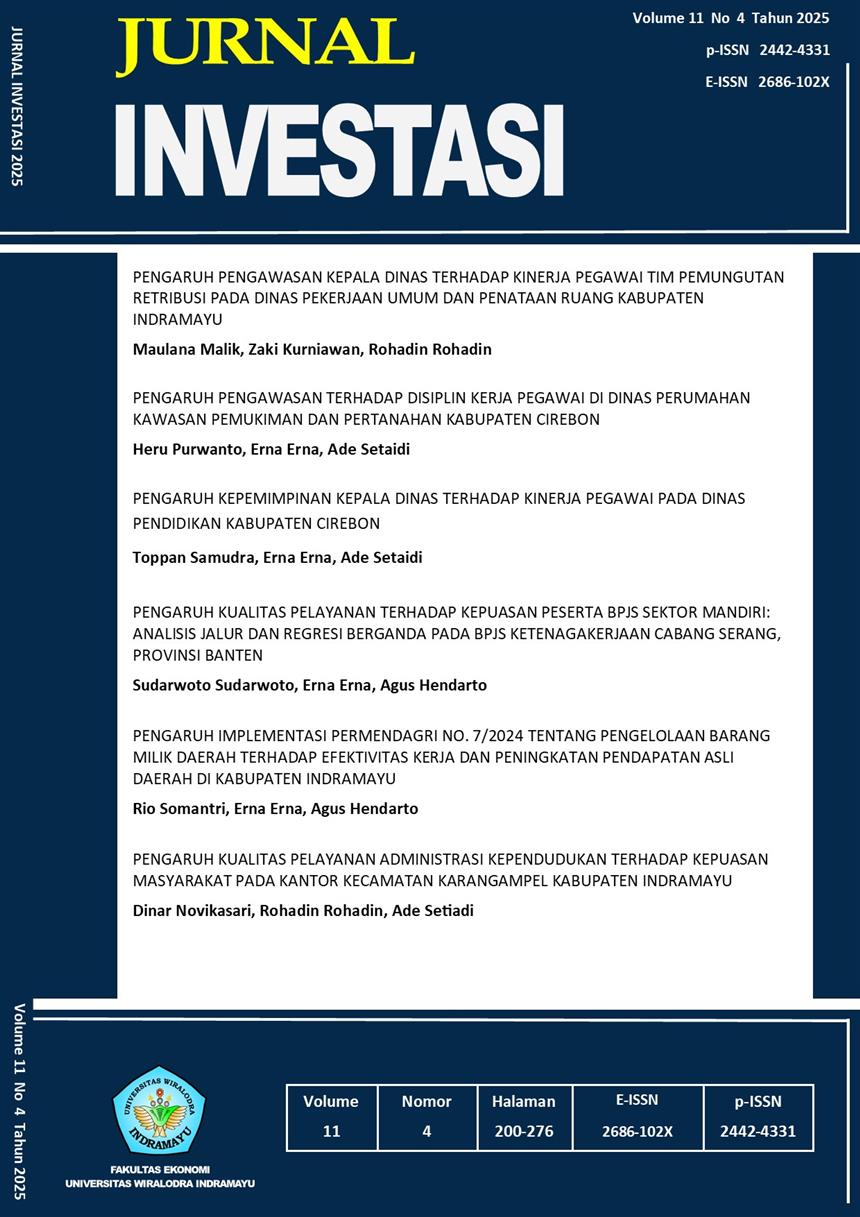
PENGARUH KEPEMIMPINAN KEPALA DINAS TERHADAP KINERJA PEGAWAI PADA DINAS PENDIDIKAN KABUPATEN CIREBON
The Influence of the Head of Department’s Leadership on Employee Performance at the Education Office of Cirebon Regency
DOI:
https://doi.org/10.31943/investasi.v11i4.363Keywords:
Leadership, employee performance, public organizations, state administration, bureaucracyAbstract
Leadership is a key factor determining the success of public organizations in achieving goals, carrying out government functions, and providing effective public services. In local government bureaucracies, the role of leaders is not only related to strategic decision-making but also to mobilizing and motivating staff to maintain work commitment, discipline, and high performance. Employee performance issues remain a common issue in government agencies, including the Cirebon Regency Education Office. Initial observations indicate suboptimal performance indicators, such as a lack of employee initiative, low task completion rates, and ineffective implementation of superior instructions. This situation suggests the need for a study on how the Head of Office's leadership contributes to improving overall employee performance.
This study aims to analyze the influence of the Head of Office's leadership on employee performance at the Cirebon Regency Education Office. The research method used was a quantitative method with an explanatory survey approach. The study population consisted of 54 employees of the Cirebon Regency Education Office, all of whom served as respondents. The research instrument was a Likert-based questionnaire that underwent validity and reliability testing. Data analysis techniques used simple linear regression, t-test, F-test, and coefficient of determination (R²) to examine the influence of leadership on employee performance.
The results showed that the leadership of the Department Head had a positive and significant influence on employee performance at the Cirebon Regency Education Department. The coefficient of determination (R²) was 0.638, meaning that the leadership variable explained 63.8% of the variation in employee performance, while other factors such as motivation, work culture, and reward systems contributed 36.2%. This research provides theoretical contributions to the development of public administration science regarding the relationship between leadership and employee performance, as well as practical implications for government agencies to strengthen participatory leadership styles, strategic supervision, and employee development to increase the productivity of public organizations..
References
Cahyana, A. (2023). Budaya organisasi dan peningkatan kinerja. Jakarta: Mitra Wacana Media.
Damanik, E. M. T. (2015). Peran gaya kepemimpinan dalam meningkatkan kinerja karyawan. Jurnal Administrasi Publik,
(2), 115–126.
Gibson, J. L., Ivancevich, J. M., & Donnelly, J. H. (2021). Organizations: Behavior, structure, processes. New York: McGraw-Hill.
Hasibuan, M. S. P. (2023). Manajemen sumber daya manusia. Jakarta: Bumi Aksara.
Khairizah, R., Suryadi, S., & Wahyudi, A. (2018). Pengaruh kepemimpinan dan komunikasi organisasi terhadap kinerja pegawai. Jurnal
Manajemen Bisnis, 8(1), 1–10.
Mangkunegara, A. A. P. (2020). Evaluasi kinerja SDM. Bandung: Refika Aditama.
Rahman, M. A., & Prasetya, A. (2018). Pengaruh kepemimpinan dan komunikasi organisasi terhadap kinerja karyawan. Jurnal Ekonomi
dan Manajemen, 14(1), 75–86.
Rivai, V. (2019). Kepemimpinan dan perilaku organisasi. Jakarta: Rajawali Pers.
Sugiyono. (2017). Metode penelitian kuantitatif, kualitatif dan R&D. Bandung: Alfabeta.
Tika, P. (2023). Kinerja pegawai dalam organisasi publik. Jakarta: Rajagrafindo Persada.
Wibowo. (2023). Manajemen kinerja. Jakarta: Rajagrafindo Persada.